
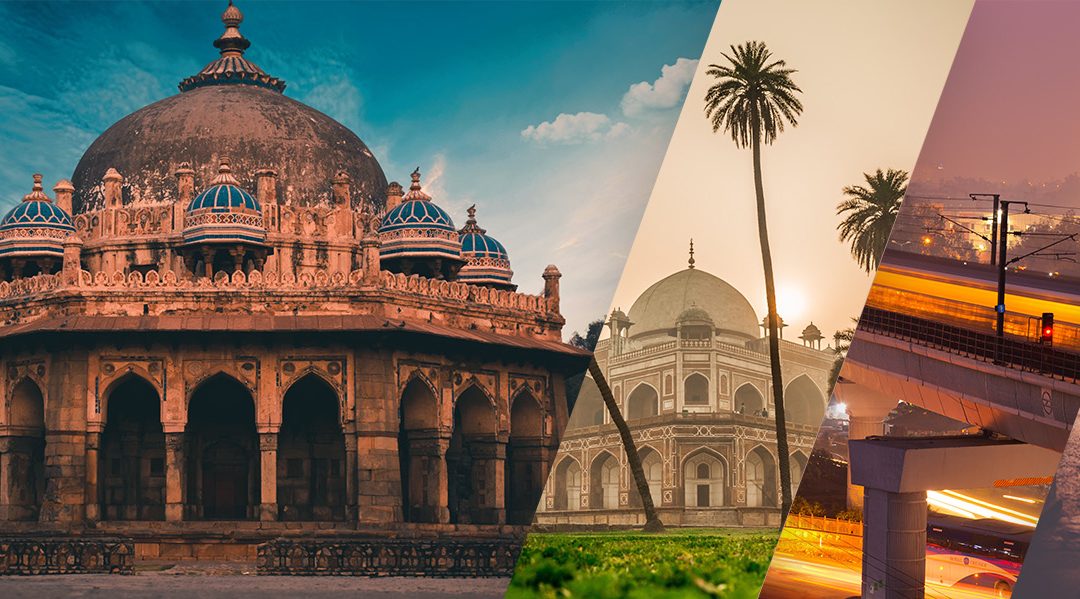
New Delhi Tourism starts with a simple fact: the capital packs eight centuries of history into one metro ride. Mughal forts, a 73-metre minaret, Lutyens’ boulevards, and Old Delhi’s food lanes all sit within a few kilometres, and most first-time visitors see the main sights in two to three days.
Key Highlights
- Three UNESCO World Heritage Sites in one city: Red Fort, Qutub Minar, and Humayun’s Tomb.
- India Gate and Kartavya Path anchor the ceremonial heart of New Delhi, best seen in the evening.
- Old Delhi offers Jama Masjid, Chandni Chowk, and some of India’s best street food in a single walk.
- October to March is the best time to visit, with cool days for walking and sightseeing.
- Delhi Metro connects the airport, the railway stations, and nearly every major sight in the city.
Delhi at a Glance
Delhi is two cities in one. Old Delhi, built by Shah Jahan in the 17th century, holds the Red Fort, Jama Masjid, and the lanes of Chandni Chowk. New Delhi, built by the British in the 1920s and 1930s, holds the wide avenues, India Gate, Rashtrapati Bhavan, and Connaught Place. The Yamuna river runs along the east edge, and the metro ties the whole spread together.
The city has been a capital for centuries, under the Delhi Sultanate, the Mughals, and the British, and each ruler left buildings that still stand. That layered past is the reason a short trip here can cover a Mughal tomb in the morning, a colonial avenue at noon, and a 400-year-old market by evening. The top facts about Delhi give a quick sense of how deep that history runs, from its eight historic cities to its place as India’s largest city by area.
Best Time to Visit New Delhi
October to March is the best time to visit Delhi. Days stay cool and dry, with temperatures around 10 to 26 degrees, and the light suits photography at the monuments. February and March are the sweet spot, with mild weather and fewer foggy mornings than December and January.
April to June is very hot, with temperatures crossing 42 to 45 degrees on open stretches like Kartavya Path. Visit early in the morning or after sunset in these months, and carry water. July to September brings the monsoon, with humidity and occasional heavy rain. Air quality can be poor from November to January, so check the air quality index before planning long outdoor days, and keep a mask handy on smoggy mornings.
Top Places to Visit in New Delhi
Red Fort (Lal Qila)
The Red Fort is the icon of Old Delhi. Shah Jahan built this red sandstone palace when he moved the Mughal capital to Delhi, and its walls run for more than 2 km along the edge of the old city. Inside, the halls, museums, and gardens take 1.5 to 2 hours to walk through. The fort is open from 9:30 am to 4:30 pm and closed on Mondays, according to Incredible India. The evening sound and light show is worth staying for.
Qutub Minar
Qutub Minar, a 73-metre minaret from the 13th century, is the tallest brick minaret in the world and a UNESCO World Heritage Site. The complex around it holds ruined mosques, carved colonnades, and the famous Iron Pillar, which has resisted rust for over 1,600 years. Early morning is the best time to visit, before the crowds and the heat arrive.
Humayun’s Tomb
Humayun’s Tomb is the early Mughal garden tomb that set the pattern for the Taj Mahal. Built in the 16th century in red sandstone and white marble, it sits in a large charbagh garden that stays peaceful even on busy days. It is a UNESCO World Heritage Site, and the light is best in the early morning or late afternoon.
India Gate and Kartavya Path
India Gate is a 42-metre sandstone arch designed by Edwin Lutyens and completed in 1931. It honours around 70,000 soldiers of the British Indian Army who died in World War I and the Third Anglo-Afghan War. The lawns around it fill with families in the evening, and the arch looks best after 6 pm, when the lights come on. Kartavya Path, the ceremonial boulevard once called Rajpath, runs from the arch to Rashtrapati Bhavan and hosts the Republic Day parade every 26 January.
Lotus Temple and Akshardham
The Lotus Temple, the Bahai House of Worship, is known for its lotus-shaped structure and its quiet prayer hall, where visitors of all faiths sit in silence. Akshardham, the large modern temple complex on the Yamuna bank, holds carved halls, exhibitions, and a musical water show in the evening. Both sit in different parts of the city, so plan them on separate halves of a day.
Jama Masjid and Chandni Chowk
Jama Masjid, built by Shah Jahan, is one of India’s largest mosques. Climb the minaret for a view over Old Delhi’s rooftops. Outside its gates, Chandni Chowk runs as the old city’s main market street, with spice shops, silver bazaars, wedding-card sellers, and sweet shops that have run for generations. A cycle-rickshaw ride through the lanes is the classic way to see it, and the kebabs and parathas near the mosque are worth the stop.
Lodhi Garden and Jantar Mantar
Lodhi Garden is the city’s best park for a slow morning, with 15th-century tombs set among lawns and walking paths. Jantar Mantar, the 18th-century astronomical observatory built in 1724 by Maharaja Jai Singh II of Jaipur, stands near Connaught Place and shows the instruments used to track the sun and stars. Both are free or cheap to enter, and both suit travellers who want a break from the big monuments.
Rashtrapati Bhavan and Connaught Place
Rashtrapati Bhavan, the President’s residence, anchors the western end of Kartavya Path. Its Mughal Gardens open to the public for a short season each spring. Connaught Place, the colonnaded shopping circle nearby, holds cafes, bookshops, and markets, and it is the easiest place in the city to spend an evening.
Food and Shopping in Delhi
Delhi’s food is a trip in itself. Old Delhi serves kebabs at Karim’s, parathas in Paranthe Wali Gali, and chaat at every corner of Chandni Chowk. Connaught Place and Khan Market hold the cafes and restaurants, while the dhabas near the railway stations serve cheap, filling meals late into the night. Try the chole bhature, the butter chicken, and the kulfi, and keep an eye on hygiene at street stalls.
For shopping, Connaught Place is the main stop, with high-street stores and the underground Palika Bazaar. Khan Market suits books, cafes, and boutiques. Janpath sells handicrafts, clothes, and souvenirs at bargain prices, while Chandni Chowk covers fabrics, jewellery, and wedding goods. Lajpat Nagar is the pick for budget clothing and home goods.
Day Trips from Delhi
Agra is the classic day trip, two hours by train on the Gatimaan or Vande Bharat Express. The Taj Mahal guide covers tickets, timings, and the best time to see the monument, which is at sunrise, before the crowds arrive.
Jaipur, the Pink City, sits about five hours by road or train, and it works as an overnight trip rather than a day trip. Its forts, palaces, and markets fill two days easily.
Mathura and Vrindavan, the towns of Krishna, lie about three hours south and suit a day trip for temple visits and the evening aarti on the Yamuna.
For trips closer to the city, the places near Delhi NCR include the Sultanpur Bird Sanctuary, the Neemrana Fort, and the heritage town of Kuchesar, all within two to three hours by road.
Sultanpur Bird Sanctuary, about 50 km from central Delhi, is best in winter, when migratory birds arrive on its wetlands. It suits a half-day trip with a morning start.
Neemrana Fort, a 15th-century fort turned heritage hotel, sits on the Delhi to Jaipur highway and works as a lunch stop or an overnight stay with its zip-line and ramparts.
Two-Day Plan for New Delhi
Day 1 covers Old Delhi: Jama Masjid in the morning, the Red Fort before lunch, Chandni Chowk by rickshaw in the afternoon, and kebabs near the mosque for dinner. Day 2 covers the rest: Humayun’s Tomb in the morning, Qutub Minar after lunch, Lodhi Garden for a walk, and India Gate and Kartavya Path at sunset.
With a third day, add the Lotus Temple and Akshardham in the morning, Jantar Mantar and Connaught Place in the afternoon, and a food walk in Old Delhi at night. Travellers with more time can spend that third day in Agra instead, and the Agra tourism guide covers the Taj Mahal, Agra Fort, and the city’s food and markets for a full day there.
How to Reach New Delhi
Delhi is one of the best-connected cities in India. Flights land at Indira Gandhi International Airport, trains arrive at three major stations, and the metro covers the city itself. Most visitors fly or take a train in, then use the metro for the sights.
By Air
Indira Gandhi International Airport is Delhi’s main airport, with flights from every Indian city and from around the world. The Airport Express Metro line connects the airport to New Delhi railway station in about 20 minutes, and taxis and app-based cabs serve the city through the day.
By Train
Delhi has three major railway stations: New Delhi, Old Delhi, and Hazrat Nizamuddin. Trains run from every part of India, and the Rajdhani and Shatabdi expresses connect the capital to the state capitals. Travellers coming from the east can check the distance from Puri to New Delhi and the trains on that route, which take around 30 hours by direct service.
By Road and Metro
Buses reach Delhi from neighbouring states, including Nepal, and the city’s ISBT terminals handle interstate traffic. Inside the city, the Delhi Metro is the fastest way to move, with lines to the airport, the railway stations, and nearly every major sight. Autos, cycle-rickshaws, and app-based cabs cover the last stretch, and the city is walkable in the central areas around Connaught Place and India Gate.
Travel Tips for New Delhi
Group your sights by area to avoid traffic. Old Delhi in one half-day, central New Delhi in another, and South Delhi for Qutub Minar and Humayun’s Tomb. Start early, since most monuments open by 9:30 am and the light and the crowds are best in the morning.
Check weekly closing days before you plan: the Red Fort is closed on Mondays, and several museums close on specific weekdays. Keep cash for small shops and rickshaws, and use the metro card for the cheapest travel. Stay in Connaught Place or Karol Bagh for central access, or in Paharganj near New Delhi station for budget rooms.
Be careful with touts near the big monuments and the railway stations, and agree on rickshaw and taxi fares before the ride. Winter mornings can be foggy, so keep flight and train timings flexible in December and January.
New Delhi rewards travellers who take it in layers: a Mughal fort in the morning, a colonial boulevard at noon, and Old Delhi’s food lanes at night. Start with the two-day plan above, and add Agra or Jaipur if you have a third day.
Frequently Asked Questions
What is the best time to visit New Delhi?
October to March is the best time to visit New Delhi, with cool, dry days around 10 to 26 degrees. February and March are the sweet spot. Avoid the extreme heat of May and June, and check air quality from November to January.
How many days are enough for New Delhi?
Two to three days cover the main sights of New Delhi. Two days handle Old Delhi, the Red Fort, Qutub Minar, Humayun’s Tomb, and India Gate. A third day adds Akshardham, the Lotus Temple, and a day trip to Agra.
What are the must-visit places in New Delhi?
The must-visit places are the Red Fort, Qutub Minar, Humayun’s Tomb, India Gate, Lotus Temple, Akshardham, Jama Masjid, and Chandni Chowk. These eight cover Mughal history, colonial Delhi, and the city’s food and markets. Group them by area to save time: Old Delhi in one half-day, central New Delhi in another, and South Delhi for the tomb and the minaret.
Is the Red Fort open on Monday?
No, the Red Fort is closed on Mondays. It is open from Tuesday to Sunday, from 9:30 am to 4:30 pm, according to Incredible India. Plan your Old Delhi day for any day except Monday. The evening sound and light show runs on open days, and it is worth staying for after the fort closes.
How do I get around New Delhi?
The Delhi Metro is the fastest way to get around New Delhi, with lines to the airport, railway stations, and most sights. Autos, cycle-rickshaws, taxis, and app-based cabs cover the last stretch, and central areas are walkable. Buy a metro card for the cheapest travel, and agree on rickshaw and taxi fares before the ride starts.
What is the nearest airport to New Delhi?
Indira Gandhi International Airport is the nearest airport to New Delhi, with domestic and international flights. The Airport Express Metro connects it to New Delhi railway station in about 20 minutes. Taxis and app-based cabs also serve the airport through the day, and the drive to central Delhi takes 30 to 45 minutes outside peak traffic.