
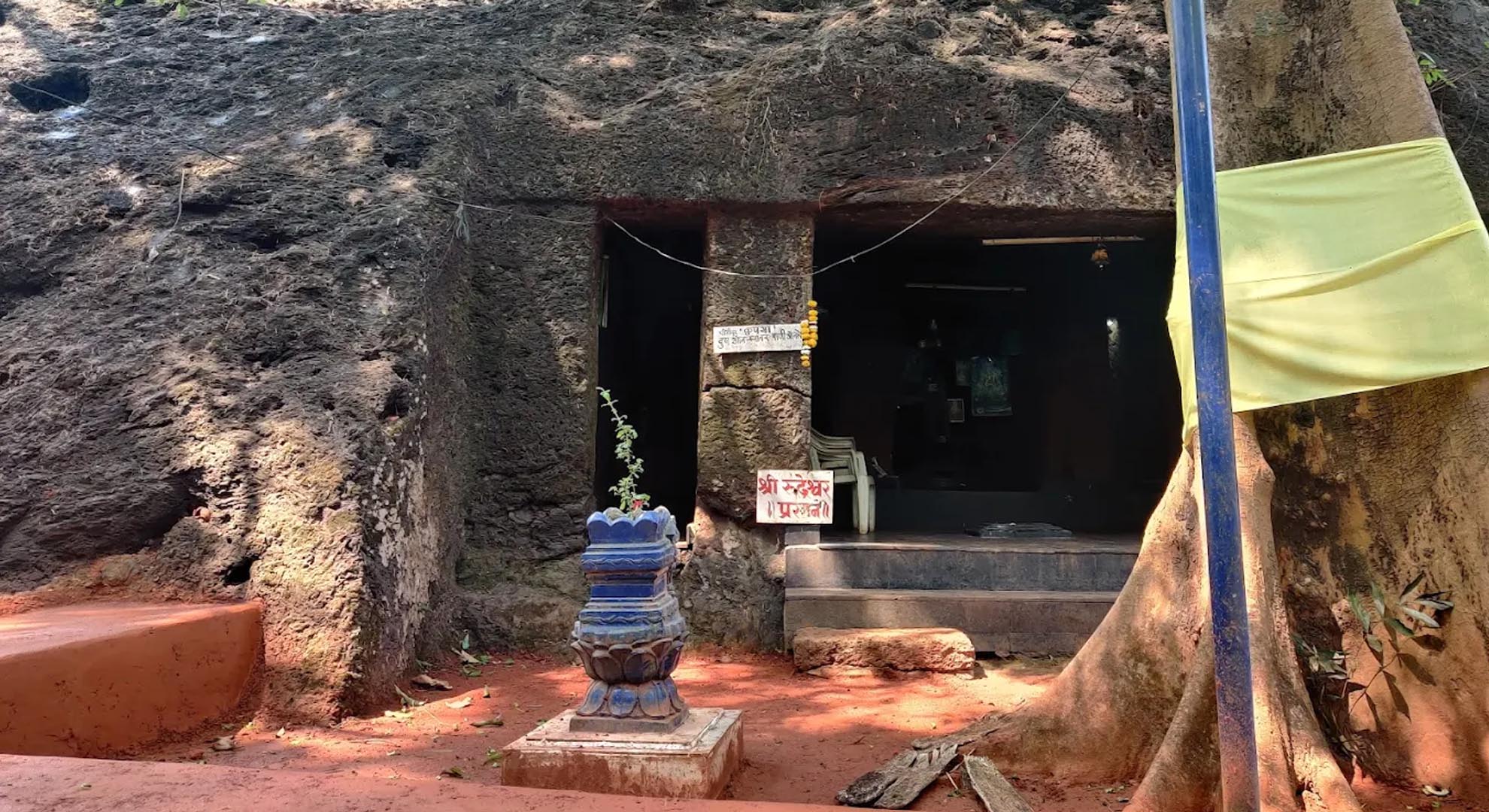
The Lamgau Caves are a pair of rock-cut caves near Bicholim in North Goa, carved by Buddhist monks in the 6th or 7th century and later used for Hindu worship. They sit in a quiet laterite hillside above Lamgau village, a short trek from the road, and they show a side of Goa that has nothing to do with beaches.
Key Highlights
- Two rock-cut caves near Bicholim, North Goa, dating to the 6th or 7th century AD.
- Carved by Buddhist monks as meditation spaces, later adapted for Hindu worship.
- Smaller cave holds a Shiva lingam, tulsi vrindavan and Nandi; the larger cave is deeper and labyrinthine.
- Free entry; best visited November to February, in daylight hours.
- 35 km from Panaji (about an hour by road); 9 km from Bicholim, then a 1 to 2 km village trek.
What the Lamgau Caves Are
The caves are cut into decomposed laterite, the soft red stone that underlies much of Goa. Buddhist monks carved them as viharas, places for meditation, study and shelter during the monsoon. The work was never fully finished: the stone is delicate, and some sections show tool marks where carving stopped. That unfinished state is part of what makes the site interesting, since it shows how rock-cut caves were actually made.
The name Lamgau comes from Lamhagram, which means the village of Buddhist monks. Local legend says the Pandavas also visited these caves, a story the site shares with other old cave groups in Goa. The caves later passed into Hindu use, and the shrine inside the smaller cave is still worshipped by villagers today.
The Government of India’s ENVIS Centre describes the caves as a major educational and cultural site in North Goa district, and notes the pavilion-like structure in the sanctum with its well-cut entablature, beams and ceiling. Areca palms grow thick in front of the caves, so the entrance stays hidden until you are close to it.
The Two Caves
The smaller cave is the more finished of the two. A pillared hall leads into a sanctum with a stone Shiva lingam, and the courtyard outside holds a tulsi vrindavan and a small Nandi bull. These are Hindu additions to a Buddhist structure, and they show how the site changed hands over the centuries. The carving here is simple, but the proportions of the hall and the ceiling beams are careful work.
The larger cave is rougher and deeper, with a complicated passage that runs into the hillside. It was most likely a dwelling and shelter for monks, used through the monsoon when the open ground turned to mud. The chambers are dark and cool, and the walls carry the faint remains of early carving. Bring a torch, since daylight reaches only the outer rooms.
Above the caves sit large open-cast iron ore mines, and the rumble of mining carries down to the site on working days. The mines have also affected the streams and lakes around Lamgau, which is one reason the caves feel neglected. The contrast is stark: ancient meditation cells below, industrial pits above.
How to Reach Lamgau Caves
By Air
The nearest airport is Manohar International Airport at Mopa in North Goa, about 35 km from Bicholim. Dabolim airport, south of Panaji, is about 60 km away. From either airport, hire a taxi to Bicholim and then on to Lamgau village. The drive from Mopa takes under an hour on the North Goa roads.
By Train
The nearest railway station is Thivim, about 20 km from Bicholim on the Konkan Railway line. Trains from Mumbai, Pune and Mangaluru stop here. From Thivim, take a taxi or a local bus to Bicholim, then an auto or taxi toward Lamgau village. Karmali station near Old Goa is another option if you are coming from the south.
By Road
From Panaji, drive about 35 km north via NH748 to Bicholim, a journey of around an hour, then follow the signs to Lamgau or Pandava Caves. From Bicholim the caves are about 9 km, a 15 to 20 minute drive. State buses run from Panaji to Bicholim, and from there you take a local auto or taxi. The last stretch starts in Lamgau village: a 1 to 2 km walk through paddy fields and palm groves on a footpath that can be rough after rain. A taxi from Panaji costs roughly Rs 380 to Rs 600, and a bus ticket costs about Rs 35 to Rs 70.
Best Time to Visit Lamgau Caves
November to February is the best time to visit the Lamgau Caves in 2026. The weather in Goa is cool and dry in these months, the paths are firm, and the light inside the caves is at its best in the morning. March to May turns hot and humid, and the walk from the village becomes tiring by midday.
Avoid the monsoon, from June to September. The trails turn slippery, the cave interiors get damp, and the stream near the site can flood the footpath. If you do visit in the rains, go with a local guide and wear shoes with grip.
Entry Fee and Timings
There is no entry fee at the Lamgau Caves, and the site is listed as open daily from 8 am to 6 pm. But access is unstaffed, and reports differ: some travel guides say the site is closed to visitors, while newer guides list daily hours. Treat it as an open heritage site with no ticket counter, and check locally in Bicholim before you set out. Go in daylight, since the caves are dark inside and the village path has no lighting.
What to See Nearby
Bicholim town itself is small, but the taluka holds more cave heritage. The Arvalem Caves near Sanquelim, also called the Pandava Caves, are a similar 6th-century rock-cut group with a laterite setting, and the Rivona Buddhist caves sit further south. Together with Lamgau they form the cave trail of North Goa, and they fit into a single day of driving.
For the other side of Goa’s heritage, Old Goa is about 30 km south of Bicholim. The Se Cathedral in Old Goa is the largest church in Asia, and Fort Aguada near Candolim gives the coastal counterpoint to Lamgau’s inland quiet. Both are easy to reach from Panaji on the same trip. If you want a fort with fewer crowds, Corjuem Fort sits on a small island in the Mandovi, and Divar Island offers a slow ferry ride through village Goa.
Travel Tips for Lamgau Caves
Start early, between 8 and 11 am, for the coolest walk and the best light. Wear sturdy shoes, since the trail is uneven and the cave floors are rough. Carry water and snacks, as there are no food stalls near the site. A torch or phone light helps in the darker chambers, and a hat and sunscreen help on the open path. Keep the caves clean, do not touch the carvings, and keep your voice low: the smaller cave is still a place of worship for the village. For a beach evening after the caves, Dona Paula beach near Panaji is on the way back.
Frequently Asked Questions
Where are the Lamgau Caves located?
The Lamgau Caves are near Lamgau village in Bicholim taluka, North Goa, about 35 km from Panaji and 9 km from Bicholim. The last 1 to 2 km is a walk from the village through paddy fields and palm groves.
How old are the Lamgau Caves?
The Lamgau Caves date to the 6th or 7th century AD. Buddhist monks carved them as meditation spaces, and they were later adapted for Hindu worship, as shown by the Shiva lingam, tulsi vrindavan and Nandi in the smaller cave.
Is there an entry fee for Lamgau Caves?
No, there is no entry fee for the Lamgau Caves. The site is an open heritage spot with no ticket counter. Access is unstaffed and reports differ on whether it is open, so check locally in Bicholim before you go.
What is the best time to visit Lamgau Caves?
November to February is the best time to visit the Lamgau Caves in 2026, when Goa is cool and dry and the paths are firm. Avoid the monsoon from June to September, when the trails turn slippery and the cave interiors get damp.
How do I reach Lamgau Caves from Panaji?
Drive about 35 km from Panaji via NH748 to Bicholim, around an hour, then 9 km to Lamgau village. State buses run from Panaji to Bicholim, and from there you take an auto or taxi. The final 1 to 2 km from the village is on foot.
What is inside the Lamgau Caves?
There are two caves. The smaller one has a pillared hall leading to a Shiva lingam, with a tulsi vrindavan and Nandi in the courtyard. The larger cave is deeper and rougher, with a labyrinthine passage that likely served as a monks’ dwelling.
The Lamgau Caves reward travellers who like their history quiet and half-hidden. Go in the winter months, start early, and pair the caves with Old Goa for a full day out from Panaji.
Weather Lamgau Caves
[location-weather id="5549"]