
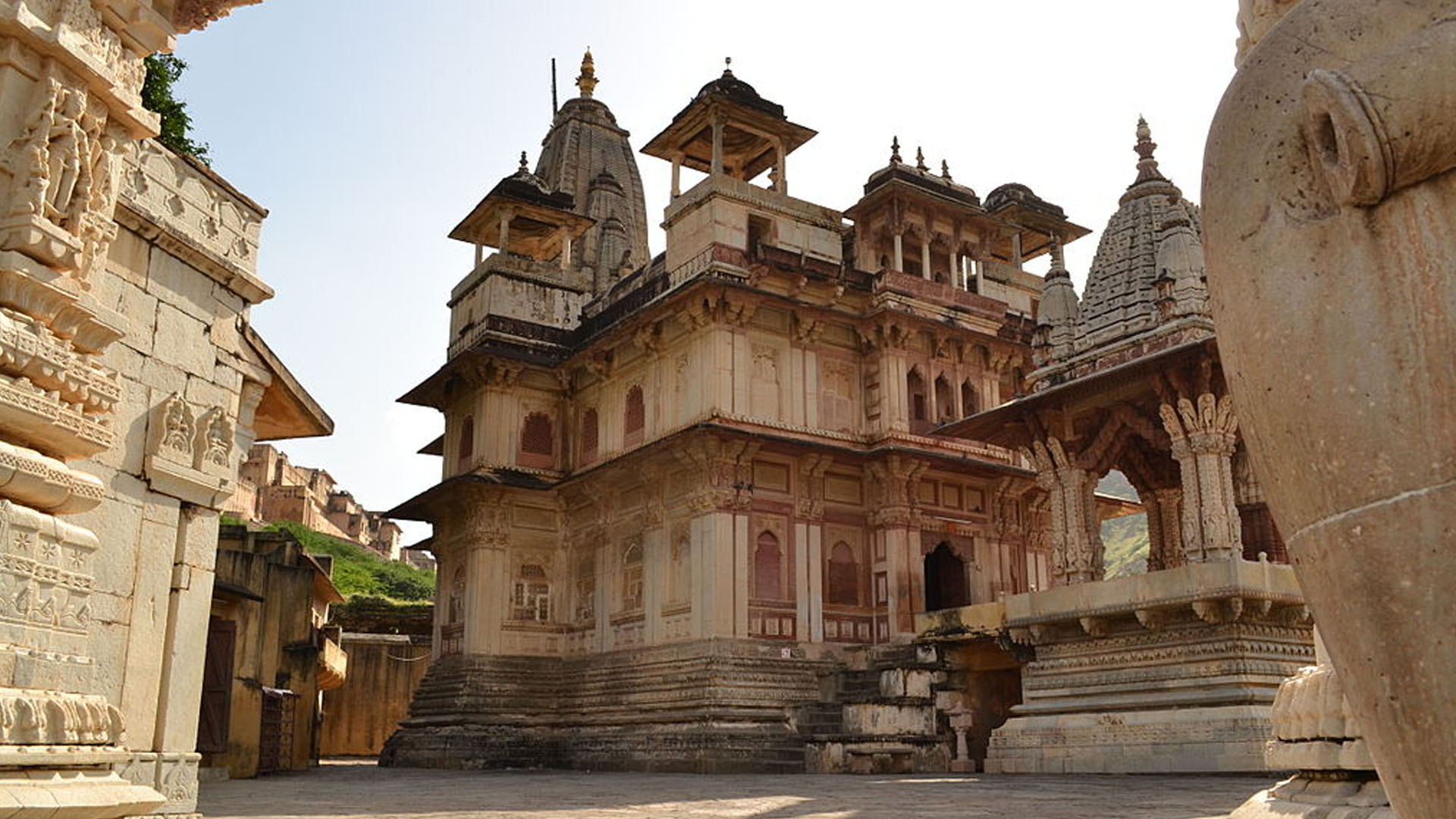
Jagat Shiromani Temple sits in the old town of Amer, a few hundred metres below Amer Fort, and it is one of the quietest corners of Jaipur. Built between 1599 and 1608, this small Krishna temple holds an idol linked by tradition to the poet-saint Meera Bai, and its marble gateway is worth the walk.

Key Highlights
- Built 1599-1608 by Queen Kanakwati in memory of her son Jagat Singh, who died in 1599 aged about 34.
- Free entry with no ticket or camera fee; allow about 45 minutes.
- Timings are about 6 AM to noon and 4 PM to 8 PM daily, with a midday break when the sanctum closes.
- The marble torana, carved from a single block and flanked by stone elephants, is the temple’s best-known feature.
- Amer Fort is 0.4 km away and Panna Meena ka Kund is a five-minute walk.
The Story Behind the Temple
Jagat Shiromani Temple is a memorial built from a mother’s grief. Raja Man Singh I’s eldest son and heir, Jagat Singh, died in 1599 at about thirty-four, before his father. His mother, Queen Kanakwati, raised this shrine in Amer town so her son’s name would keep being spoken in prayer, and construction is generally dated between 1599 and 1608.
Man Singh served as a senior commander under the Mughal emperor Akbar, and that contact shows in the temple’s lattice screens and cusped arches, set into an otherwise Nagara-style plan. When the court moved to the new city of Jaipur in 1727, Amer emptied of power but not of worship, and the temple has stayed a working shrine ever since. Readers curious about the wider story of the Pink City can start with these facts about Jaipur before planning the Amer half of the day.
The Meera Bai Connection
Inside the garbhagriha, Krishna in dark stone stands beside Vishnu and, unusually, Meera Bai herself. Her songs to Krishna are still sung across Rajasthan, and this is one of very few temples in India where the devotee is enshrined as a figure of worship next to her deity. That single fact draws devotees who would otherwise walk straight past Amer town to the fort.
Local tradition holds that the Krishna idol here was Meera’s own, carried from Chittorgarh in Mewar to Amer for safekeeping. Treat that as cherished legend rather than documented history. Either way, the pairing gives this small building a tenderness the great fort above it never attempts.
Architecture Worth Stopping For
The first thing you meet is the torana, a ceremonial arch cut from a single block of marble. Life-size stone elephants flank it, and its surface is crowded with deities, musicians and processions carved in relief. Toranas of this kind are more often seen in Jain temples, which makes this one unusual in a Hindu shrine. Behind it rises a sandstone shikhara, and opposite the sanctum door stands a small mandapa sheltering a stone Garuda, the classic signature of a Vaishnava temple.
Three stones are in play here: local sandstone, white marble and a dark stone for the sanctum, and the contrast is half the pleasure. The carving programme of elephants, horses, celestial musicians and mythological processions belongs to the high Amer workshop tradition of the period, and travellers who want the wider context can read these interesting facts about Rajasthan travel before visiting. The pillars and walls carry mythological scenes and floral patterns, and the whole building takes under an hour to see slowly.
How to Reach Jagat Shiromani Temple
Amer town sits about 11 km north of central Jaipur along Amer Road, past Jal Mahal. The temple stands roughly 400 metres from Amer Fort, on the town side, and the easiest approach is on foot through the Amer bazaar. Drivers should park near Maota Lake at the base of the fort, since the temple lanes are narrow and fill by mid-morning.
By Air
Jaipur International Airport is about 20 to 24 km from the temple, roughly a 55-minute drive depending on traffic. App cabs and prepaid taxis run from the airport to Amer; agree the fare first, and ask to be dropped at the Maota Lake parking area.
By Train
Jaipur Junction is about 11 to 14 km from Amer town, around 35 minutes by road. From the station, take an auto-rickshaw or app cab north along Amer Road, or a JCTSL city bus from Chandpole or Badi Chaupar to the Amer bus stand, a ten-minute walk from the temple.
By Road
From Jaipur city, Amer Road is the direct route, and the drive takes 30 to 40 minutes from the old city. The Metro’s Pink Line does not reach Amer; Chandpole, about 9 km away, is the most useful station, and from there you continue by auto or cab. Within Amer town everything is on foot.
Best Time to Visit
October to March is the best season, and a 7 to 9 AM start gives you the courtyard almost to yourself. April to June regularly crosses 40°C in Amer, so if you must visit then, finish by 10 AM. Late afternoon, from 4 to 6 PM, is the second-best slot, with the evening aarti as a bonus.
Crowds stay low for most of the year, which is rare in Amer. Janmashtami, in August or September, and Radha Ashtami are the exceptions, when the temple fills with devotees; go early or accept the crush. Similar crowds gather for Janmashtami at Govind Dev Ji Temple in Jaipur city, so plan the same way if you visit both shrines.
Entry Fee and Timings
Entry is free: no ticket counter, no camera fee and no fixed donation, and prasad, usually a sweet or a few tulsi leaves, is offered without charge. Ignore anyone who suggests a compulsory offering. Timings are about 6 AM to noon and 4 PM to 8 PM, with the sanctum closed for a midday break, and hours shift with the season and on festival days.
Nearby Places to Visit
Amer Fort is the obvious next stop, 0.4 km away through Suraj Pol. Its four courtyards, the frescoed Ganesh Pol and the mirrored Sheesh Mahal take two to three hours, so visit the temple first and the fort second. Panna Meena ka Kund, a five-minute walk away, is a stepped well photographers love in the morning light.
Jaigarh Fort sits on the hill above Amer and holds the Jaivana, the largest cannon on wheels of its era. Nahargarh Fort, further along the Aravalli crest, gives the fullest panorama of Jaipur at sunset. Back in the city, Galtaji Temple makes a good second temple stop for travellers who enjoy sacred sites away from the main circuit.
Travel Tips for Visitors
Dress modestly, remove shoes at the step, and keep voices low inside. The courtyard has partial wheelchair access and no stroller access.
For food, Amer town has halwai stalls around Ganesh Chowk serving vegetarian kachoris, but for a guaranteed meal, eat back in Jaipur.
Carry water in summer, and keep your inbound auto waiting, since return pickups from the temple lanes can be slow. Moti Dungri Temple, the Ganesh shrine on a small hill near the old city, is another short temple visit that fits the same day if you are back in Jaipur by afternoon.
Frequently Asked Questions
Where is Jagat Shiromani Temple located?
Jagat Shiromani Temple stands in Amer town, about 11 km north of central Jaipur in Rajasthan, roughly 400 metres from Amer Fort on the town side. The nearest railway station is Jaipur Junction, about 11 to 14 km away, and Jaipur International Airport is about 20 to 24 km away.
What are the timings of Jagat Shiromani Temple?
The temple is open about 6 AM to noon and 4 PM to 8 PM every day, with the sanctum closed for a midday break. Timings shift with the season and on festival days, so confirm locally. Early morning from 7 to 9 AM is the best time to visit.
Is there an entry fee for Jagat Shiromani Temple?
No, entry is completely free. Jagat Shiromani Temple is a working temple with no ticket counter, no camera fee and no fixed donation, and prasad is offered without charge. Ignore anyone near the gate who suggests a compulsory offering or a camera charge.
Why is Jagat Shiromani Temple famous?
The temple is famous for its link to Meera Bai, the sixteenth-century bhakti poet-saint, whose idol stands beside Krishna in the sanctum, which is rare in India. It is also known for its marble torana carved from a single block, its blend of Hindu, Jain, Mughal and South Indian styles, and its history as a memorial built by Queen Kanakwati for her son.
Who built Jagat Shiromani Temple?
Queen Kanakwati, the wife of Raja Man Singh I of Amer, built the temple between 1599 and 1608 in memory of her son Jagat Singh, who died in 1599 aged about thirty-four. It is one of the rare major royal monuments of the period commissioned by a queen for her son rather than by a king for himself.
How much time is needed to visit Jagat Shiromani Temple?
About 45 minutes is enough for a relaxed visit, including the torana, the sanctum and the Garuda mandapa, with time for the carvings. Most visitors combine it with Amer Fort, 0.4 km away, and Panna Meena ka Kund, five minutes on foot.
Jagat Shiromani Temple rewards the traveller who stops instead of rushing up to the fort. Go early, stand a while under the marble torana, and then walk the short lane to Panna Meena ka Kund before the crowds arrive.
Weather Jagat Shiromani Temple Jaipur
[location-weather id="5549"]