
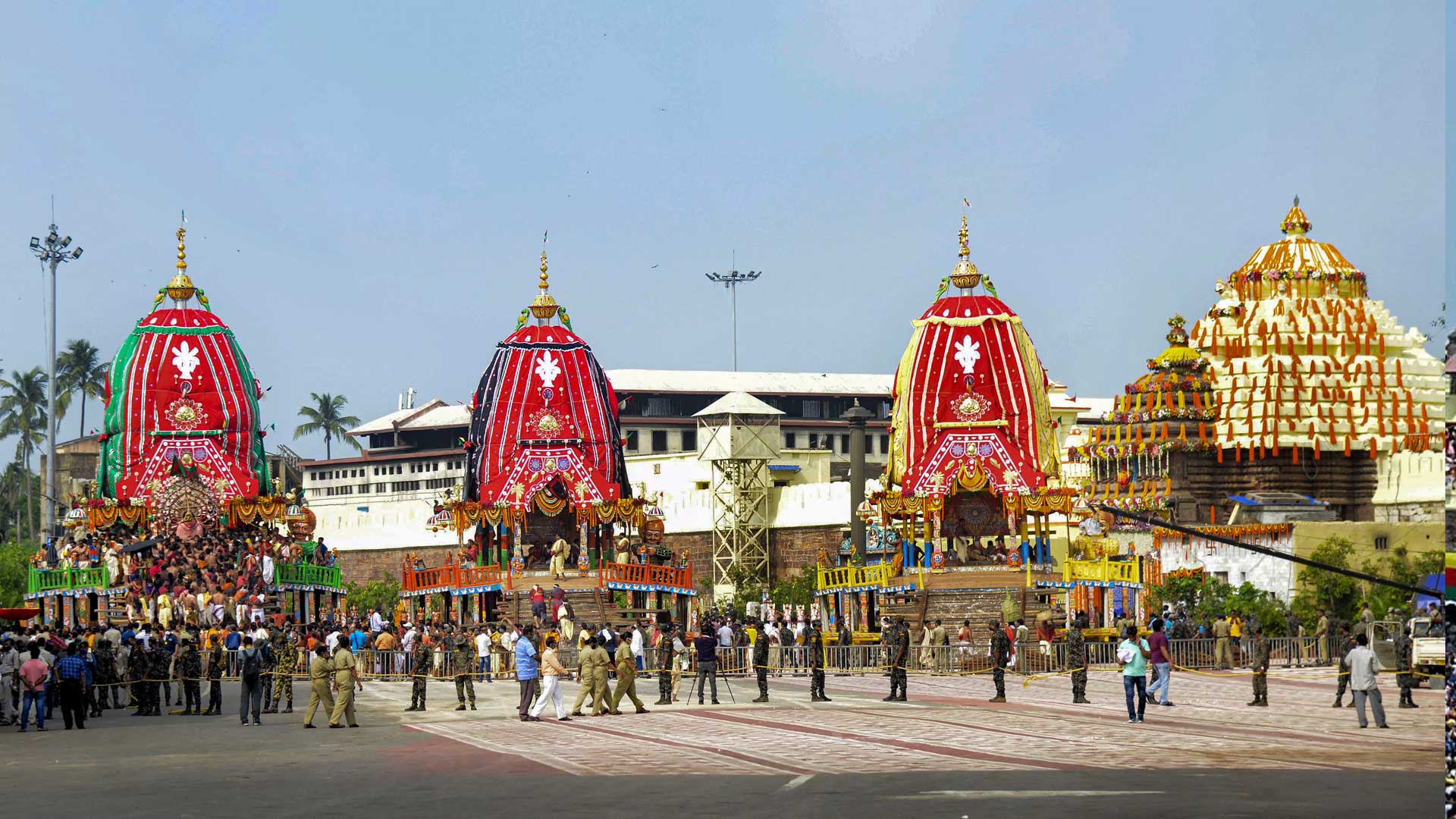
The Jagannath Temple Paradeep is the port town’s best-known shrine, a modern Jagannath temple at Sandhakuda village raised by the port community between 1984 and 1990. Unlike Puri’s ancient original, this is a working neighbourhood temple with a documented 20th-century history, daily worship of the neem-wood trio, and a Rath Yatra that pulls the town’s crowds. Here is its history, festivals, darshan practicalities and how to reach it.
Key Highlights
- The temple’s history is documented in Orissa Review (July 2010): the Jagannath Samaj formed in 1972, idols were first worshipped in a thatched house on Akshaya Tritiya 1974, and the permanent temple on 5 acres at Sandhakuda village was commissioned on 27 April 1990.
- The presiding deities are the neem-wood trio, Jagannath, Balabhadra and Subhadra, following the Puri tradition, with the Port Trust’s chairmen playing a recorded role in the temple’s construction.
- Rath Yatra is the headline festival; the calendar also includes Makar Sankranti, Kartik Purnima and Janmashtami observances.
- Darshan timings vary across sources (reported windows range from 5 AM–4 PM to 6 AM–8 PM), so treat published timings as indicative and confirm locally; entry is free.
- Nearest railway station is Paradip (about 8–11 km); the nearest airport is Biju Patnaik International Airport, Bhubaneswar (about 118–125 km). October to February is the best visiting season.
History: A Temple the Port Built
Most Jagannath temples in Odisha are old; this one is young, and its story is unusually well recorded. According to Orissa Review (July 2010), devotees in the port town formed the Jagannath Samaj in 1972; on Akshaya Tritiya 1974 the idols were installed in a thatched house and worship began. The permanent temple took shape between 1984 and 1990 on five acres at Sandhakuda village, with the Paradip Port Trust chairmen recorded as patrons of the construction, and it was commissioned on 27 April 1990. Few modern temples have their founding decade on the public record in a government magazine, and that documented timeline is this shrine’s real distinction.
Architecture and the Divine Trio
The temple follows the familiar Kalinga vocabulary: a rising curvilinear tower over the sanctum and a pillared audience hall, executed in 20th-century stonework rather than medieval carving. Some travel blogs describe wave and boat motifs carved into the walls, a nod to the port; that detail is unverified, so take it as colour rather than fact. Inside the sanctum sit the three neem-wood (daru) idols of the Puri tradition, Jagannath, Balabhadra and Subhadra, with large painted eyes and stylised forms recognisable to anyone who has seen the Puri originals. One hotel website mentions a 60-ft Aruna Stambh (sun pillar) on the premises (a single-source claim, worth checking in person rather than planning around). The complex is compact and well kept, with clean courtyards, a kitchen for Mahaprasad, and space for the Rath Yatra chariots. For the older Jagannath tradition in the region, the Jagannath Temple at Rayagada and the Jagannath Temple at Sabarang, Bhadrak show how the same deity is worshipped in very different settings across Odisha.
Festivals Through the Year
Rath Yatra is the temple’s biggest event. The three chariots roll through the port town on the same Ashadha schedule as Puri, and the procession draws crowds from across Jagatsinghpur district, the one day the temple complex genuinely overflows. Makar Sankranti in January brings special offerings, Kartik Purnima sees the Boita Bandana-style lamp-floating observance common across coastal Odisha, and Janmashtami is celebrated with night-long kirtan. Snana Purnima, the ceremonial bathing of the deities before Rath Yatra, is observed here too. For the festival at full scale come at Rath Yatra; for calm darshan, choose the winter months.
Darshan Timings and Mahaprasad
Published darshan timings conflict: sources variously report 5 AM–4 PM, 6 AM–8 PM and 5 AM–8 PM windows. None is official, so treat all three as indicative and confirm with the temple office or a local before planning a tight schedule. The safe pattern, as at most Odisha temples, is morning worship from around 6 am, a midday break, and evening darshan. Entry is free. On Mahaprasad, a correction is due: some blogs claim the temple serves the famous 56-item (chhapan bhog) spread. That 56-dish figure is documented for Puri’s temple, not for Paradeep; the temple does serve Mahaprasad in the Puri tradition, but the exact 56-item count is unverified here, so do not quote it as fact. Prasad is typically available at the temple counter around midday; on festival days it runs out early.
How to Reach Jagannath Temple Paradeep
By Air
The nearest airport is Biju Patnaik International Airport, Bhubaneswar, about 118–125 km away (sources vary; treat as approximate). From the airport, take a taxi or a bus toward Cuttack–Paradip; the drive takes roughly 3–3.5 hours depending on traffic.
By Train
Paradip has its own railway station, about 8–11 km from the temple (sources vary), with connections to Cuttack, Bhubaneswar and Kolkata. From the station, autos and taxis run to Sandhakuda and the port-town area. Cuttack Junction, the bigger railhead about 90–100 km away, has far more train options if Paradip’s limited services do not suit your timing.
By Road
Paradeep (also spelled Paradip) sits at the end of the Paradip–Cuttack highway, with regular OSRTC and private buses from Cuttack and Bhubaneswar, about a 3-hour drive. Within town, the temple at Sandhakuda village is an easy auto-rickshaw ride from the bus stand.
Best Time to Visit
October to February is the comfortable window, with daytime temperatures in the high 20s, low humidity, and the sea breeze working in your favour. For the 2026 season this remains the recommended period. Rath Yatra (June–July) is the festival peak but brings heat, humidity and crowds. March to May is hot and best avoided for a relaxed visit; the monsoon (June–September) brings heavy rain to the coast. Winter mornings give you the temple nearly to yourself and the beach at its best in the same trip.
Nearby Places Worth Adding
Paradip Beach is the natural second stop, a working-port beach with a long sandy stretch, best visited in the early morning before the fishing boats return. The Paradip Port viewpoint area gives a sense of the industrial coastline that funds this town. An hour’s drive away, Kendrapara district offers the Gojabayani Temple, a Shakti shrine worth the detour if you are temple-hopping. Travellers heading back toward Bhubaneswar can break the journey in the old town: the Baitala Temple, with its distinctive Khakhara roof and tantric iconography, and the Ananta Vasudeva Temple, the city’s celebrated Vishnu shrine, sit within a short drive of each other and pair well as a single afternoon’s circuit.
Travel Tips
- Dress modestly: covered shoulders and knees are expected; men may be asked to remove shirts before entering the sanctum, as at Puri.
- Leave footwear at the designated stand: do not carry shoes into the temple complex.
- Non-Hindus should check current entry practice at the gate; customs at Jagannath temples vary and the staff’s word is final.
- Carry cash for prasad and donations; digital payments are unreliable at the temple counter.
- On Rath Yatra day, arrive by early morning; roads near the temple close to vehicles and parking fills fast.
- Combine the temple with Paradip Beach in one trip, but swim only where locals do; port-adjacent waters have currents and restricted zones.
Frequently Asked Questions
Where is the Jagannath Temple in Paradeep located?
The temple stands at Sandhakuda village in the port town of Paradeep (Paradip), Jagatsinghpur district, Odisha, on a five-acre complex. It is about 8–11 km from Paradip railway station and easily reached by auto-rickshaw from the town’s bus stand and beach road.
When was the Jagannath Temple Paradeep built?
The permanent temple was built between 1984 and 1990 and commissioned on 27 April 1990, according to Orissa Review (July 2010). The worship history starts earlier: devotees formed the Jagannath Samaj in 1972, and the idols were first worshipped in a thatched house on Akshaya Tritiya 1974.
What are the darshan timings of Jagannath Temple Paradeep?
Published timings conflict: sources report windows from 5 AM–4 PM to 6 AM–8 PM, and none is official. As a rule of thumb, expect morning worship from around 6 am with a midday break and evening darshan, and confirm with the temple office before a tightly scheduled visit.
Does the temple serve Mahaprasad?
Yes, Mahaprasad is served in the Puri tradition, usually available at the temple counter around midday. One correction: the famous 56-dish (chhapan bhog) count is documented for Puri’s temple, not verified for Paradeep, so do not treat it as fact here. On festival days the prasad runs out early.
How do I reach Paradeep from Bhubaneswar?
By road it is about a 3-hour drive (roughly 120 km) via Cuttack, with regular OSRTC and private buses. By train, take a service to Paradip station (limited) or Cuttack Junction (many more trains) and continue by road. The nearest airport is Biju Patnaik International Airport, Bhubaneswar, about 118–125 km away.
Which festival is the biggest at Jagannath Temple Paradeep?
Rath Yatra is the headline festival, with the three chariots rolling through the port town on the Ashadha schedule and crowds arriving from across Jagatsinghpur district. The wider calendar also includes Makar Sankranti, Kartik Purnima, Janmashtami and Snana Purnima observances.
Time your visit for a winter morning darshan, walk the beach the same day, and confirm the day’s timings at the gate; this young, well-documented temple rewards visitors who arrive with the facts straight.
Weather Jagannath Temple
[location-weather id="5549"]