
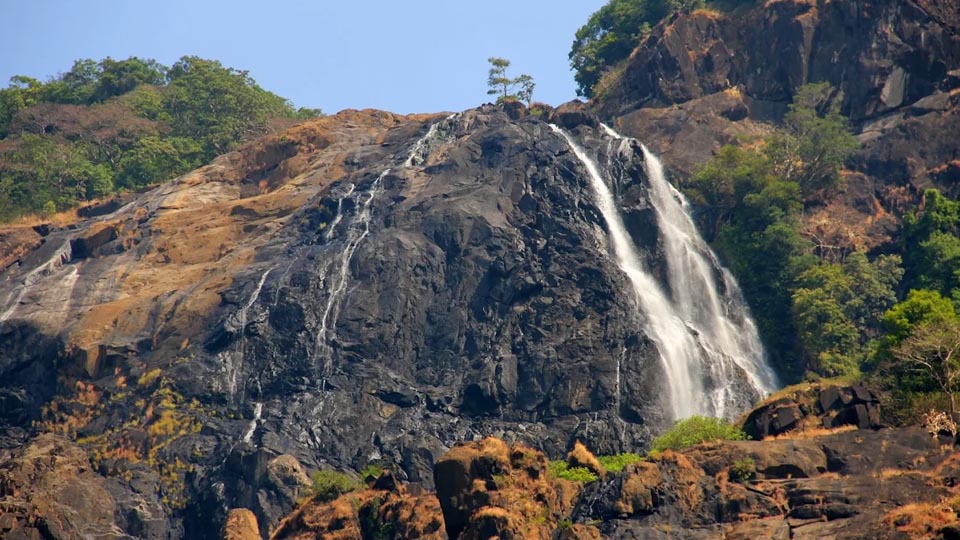
Dudhsagar Waterfall is Goa’s tallest and most famous waterfall — a four-tiered cascade about 310 metres high on the Mandovi river, right on the Goa–Karnataka border inside the Bhagwan Mahavir Wildlife Sanctuary and Mollem National Park. Its name means “sea of milk”, and on a good post-monsoon morning the description fits perfectly: the river drops off a near-vertical cliff face and explodes into white foam and spray. You can’t drive to the falls in your own vehicle; the only sanctioned way in is a Forest Department-registered jeep from the village of Collem (Kulem), and the safari season runs roughly October to May. Plan a full day, start early, and book your jeep slot ahead on the GTDC portal if you are visiting on a weekend.
Key Highlights
- Location: Bhagwan Mahavir Wildlife Sanctuary and Mollem National Park, Sanguem taluka, on the Goa–Karnataka border — about 60 km by road from Panaji.
- Height and tiers: about 310 metres (the Forest Department gives 306 m), dropping in four tiers through thick Western Ghats forest.
- How to reach: only in Forest Department-registered jeeps from Collem (Kulem); the forest track is 10–12 km each way with several stream crossings. Private cars and bikes are stopped at the entry gate.
- Season: the falls are closed to visitors in the monsoon (roughly June to September); the jeep season normally runs October to May. Bookings for the current season are made on the GTDC’s authorised portal.
- Don’t miss: the rail bridge view — the Goa–Londa railway line crosses right by the falls, and passengers on trains along this line get the classic Dudhsagar postcard shot.
About Dudhsagar Waterfall
Dudhsagar is not a waterfall you just stumble upon. It sits deep inside one of Goa’s oldest protected forests, where the Mandovi river — known in its upper reaches as the Mhadei — tumbles down the Western Ghats escarpment at the Karnataka border. The river rises at a cluster of springs at Bhimgad in Belagavi district, Karnataka, gathers force through the Ghats, and then lets go: 310 metres of it, in four distinct tiers, landing in a green pool before flowing west towards the Arabian Sea.
The falls rank among India’s tallest waterfalls, and they are comfortably Goa’s tallest. That height, combined with the volume of water just after the monsoon, is what makes the trip worth the long day. October and November are the sweet spot — the flow is still thunderous from the rains, the forest is washed clean and green, and the sky has mostly cleared.
Local legend has it that a princess of the Ghats used to bathe in a lake near her father’s palace, and afterwards drink a jug of milk from a golden pitcher with her maids. One day a prince passed through the forest and stopped to watch. To screen the princess while she dressed, her maids poured the milk down the hillside in a white curtain — and the falls have flowed like milk ever since. It is a story, not history, but it tells you something about how long these falls have held the local imagination.
How to Reach Dudhsagar Waterfall
First, get yourself to Collem — spelt Kulem on railway boards. That village is the base for every legal trip to the falls. From there, only Forest Department-registered jeeps go in, through a forest track that crosses streams and rough ground before ending a short walk from the pool at the foot of the falls.
By Air
Goa International Airport at Dabolim is the nearer of the state’s two airports for this trip. Manohar International Airport at Mopa sits in the far north of Goa and makes for a longer drive. From either airport, hire a taxi to Collem; the last stretch is on the Panaji–Belagavi highway towards Mollem.
By Train
Kulem (station code QLM) is the nearest railway station to the jeep stand, on the South Western Railway line running from Vasco da Gama towards Londa in Karnataka. Madgaon (Margao), with far more long-distance connections, is the bigger railhead on the same line, about 46 km west of Dudhsagar along the route. Be aware that walking along the railway track to the falls is illegal and dangerous — it is trespassing on a busy mountain railway, and the Forest Department does not permit entry to the falls from the track. Indian Railways has also barred passengers from boarding or getting off at the small Dudhsagar halt.
By Road
Dudhsagar is about 60 km by road from Panaji. Drive or take a taxi east on the Panaji–Belagavi highway towards Mollem, then turn off for Collem; Kadamba (KTC) buses also run towards Mollem and Collem. Park at the designated area in Collem and switch to an authorised jeep — self-driving into the sanctuary is not allowed. The jeep ride itself takes 45–60 minutes each way, and from the drop-off point it is a short rocky walk (around 200–500 metres) to the base of the falls.
Best Time to Visit Dudhsagar Waterfall
The jeep safari operates roughly from October to May; the exact opening date depends on the monsoon and is announced by the Forest Department each year. For the 2026 season, the circuit is open from early October onward, and bookings run through May.
October to December is the best window. The falls are still in full flow after the rains, the forest is at its greenest, and the weather is pleasant. By April and May the volume drops noticeably, though the trip still runs. The monsoon (roughly June to September) is when the falls are at their most powerful — and when you cannot go. The Forest Department closes Dudhsagar to visitors in the rains because the river turns dangerous; during the 2026 monsoon the authorities also restricted visits to waterfalls and rivers across South Goa for safety. Anyone promising you a monsoon trek to the falls is asking you to break the law and risk your life — politely decline.
Things to Do at Dudhsagar
The jeep safari
This is the trip itself, and it is an experience on its own: a bumpy, rutted forest track through Bhagwan Mahavir Wildlife Sanctuary, three or more stream fordings depending on the water level, and dense evergreen forest on both sides. Jeeps carry up to seven people, and if you turn up alone or as a couple you may wait until a jeep fills — another reason to reach Collem early, since entry gates close in the afternoon and the daily trip cap can be reached on busy days. Expect to spend about an hour and a half at the falls before the jeep heads back.
Swim at the base (with a life jacket)
Swimming is allowed only in the designated area at the foot of the falls, and a life jacket is compulsory — entering the water without one is prohibited. Lifeguards and forest guards are posted at the site. The pool is shared with plenty of other visitors on a busy day, so set your expectations accordingly: this is a joyful dip under one of India’s great waterfalls, not a private lagoon.
The rail bridge viewpoint
The railway line from Goa to Londa passes remarkably close to the falls, and the train crossing the bridge with the cascade behind it is the most photographed sight at Dudhsagar. If you are arriving by rail anyway, keep your camera ready on the stretch near the falls, especially in and just after the monsoon when the flow is strongest.
Devil’s Canyon
En route through the sanctuary, the track passes Devil’s Canyon — a narrow gorge where the river runs between steep rock walls. It makes a fine photo stop; ask your jeep driver or guide to point it out.
Entry Fee & Timings
Fares and rules are set fresh each season, so treat the figures below as a guide and confirm current charges on the GTDC booking portal or with the Forest Department before you go. For the 2026 season, entry gates are open from 8 am to 3 pm, with visitors sent in batches, and trips are capped per day on the recommendation of the State Board for Wildlife. The sanctuary entry fee follows the Forest Department’s schedule (₹20 for adults, ₹10 for children), and the jeep fare is charged per person — counter bookings have been reported around ₹800–900 per person including the forest entry, life jacket and guide, with a small discount for online booking. Plastic bottles and carry bags are not allowed on the trip, and anyone found drunk or carrying alcohol faces strict action.
Nearby Places to Visit
Dudhsagar sits in a corner of Goa that rewards a full day out. The Tambdi Surla Mahadev temple, Goa’s oldest surviving temple, hides in the same forest belt and is an easy add-on for history lovers. The sanctuary’s Nature Interpretation Centre at Mollem is worth a stop if you travel with children. Most jeep packages pair the falls with a spice plantation visit and a Goan thali lunch — a combination that has become the standard Dudhsagar day trip. If you are building a longer south Goa itinerary, the cliff-top fort at Cabo de Rama and the quiet beaches further down the coast — Palolem, Polem and the hard-to-reach Kakolem — sit on the same side of the state and pair naturally with an inland day at the falls. Closer to the north, Chapora makes a good evening stop on your way back from Collem.
Travel Tips
- Start early. Reach Collem in the morning — the drive in, the queue, the jeep ride and the walk add up, and the gates close at 3 pm. Early visits also mean better light for photographs and thinner crowds.
- Book ahead on weekends. Jeep slots are capped per day, and the counter queues fill fast in season. Booking through the GTDC portal saves you a long wait in Collem.
- Wear shoes with grip. The last stretch from the jeeps to the pool is over rough, wet rock. Flip-flops are a mistake you will regret.
- Carry snacks and take your rubbish back. Plastic bottles and carry bags are banned on the trip, so decant water into a reusable bottle and carry food in a cloth bag. There is very little to buy at the falls.
- Expect monkeys. They are bold around food at the falls. Keep snacks packed away and do not feed them.
- Leeches and rain gear. If you visit early in the season (October), the forest can still be damp — leeches are possible on the walk, and a light rain jacket is sensible.
- Respect the lifeguards. Currents below the falls are stronger than they look. Swim only where the staff allow, and keep the life jacket on.
Frequently Asked Questions
Is Dudhsagar Waterfall open during the monsoon?
No. The Forest Department closes Dudhsagar to visitors in the monsoon, roughly June to September, because the river becomes dangerous. The jeep circuit usually reopens in October, with the exact date announced each year after the rains.
How do I book the Dudhsagar jeep safari?
Trips run in Forest Department-registered jeeps from Collem (Kulem) and are booked through the GTDC’s authorised online portal. You can also buy tickets at the counter in Collem, but on weekends the daily cap means you may face long waits — booking ahead is the safer option.
What are the Dudhsagar Waterfall timings and entry fee?
For the 2026 season, entry gates are open from 8 am to 3 pm. The sanctuary entry fee is around ₹20 for adults and ₹10 for children, plus a per-person jeep fare that is set each season — check the GTDC portal for current figures before you go.
Can you swim at Dudhsagar Waterfall?
Yes, but only in the designated area at the base of the falls, and a life jacket is compulsory — entering the water without one is prohibited. Lifeguards and forest guards are posted at the site, and you should swim only where they allow it.
Can I trek to Dudhsagar along the railway track?
No. Walking along the railway track is dangerous and illegal, and the Forest Department does not allow entry to the falls from the track. Indian Railways has barred passengers from boarding or getting off at the Dudhsagar halt, so the train is for viewing only.
How tall is Dudhsagar Waterfall?
About 310 metres (just over 1,000 feet), dropping in four tiers — the Goa Forest Department gives 306 metres. It is Goa’s tallest waterfall and one of the tallest in India.
Weather Dudhsagar Waterfall
[location-weather id="5549"]