
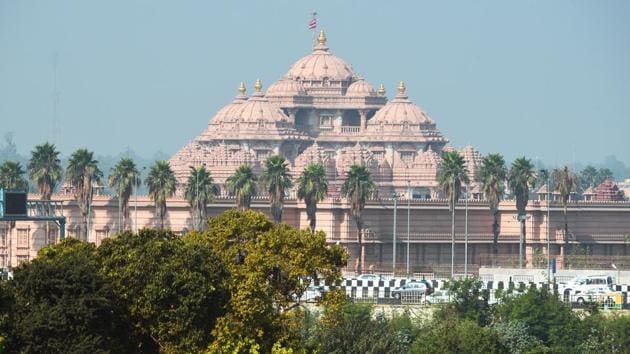
Akshardham Temple in Jaipur is a modern Swaminarayan temple dedicated to Lord Narayan (Lord Vishnu), located in the Vaishali Nagar area of Jaipur, Rajasthan. Built by the Bochasanwasi Shri Akshar Purushottam Swaminarayan Sanstha (BAPS), it stands out for its carved pink-sandstone and white-marble architecture, landscaped gardens, museum, and library. Entry is free, and the temple is open Tuesday to Sunday, 7:30 AM–12:00 PM and 4:00 PM–8:15 PM.
Key Highlights
- Location: Vidyut Nagar, Vaishali Nagar, Chitrakoot, Jaipur 302021 — about 6 km from Jaipur Junction railway station and 13 km from Jaipur International Airport.
- Timings: 7:30 AM–12:00 PM and 4:00 PM–8:15 PM, Tuesday to Sunday; closed on Mondays. Entry is free of charge.
- Dedicated to Lord Narayan (Lord Vishnu) with a central shrine of Lord Swaminarayan; built by BAPS in modern Hindu architectural style with pink sandstone, white marble, and intricately carved pillars and domes.
- Best time to visit: October to March, when Jaipur’s weather is pleasant; morning aarti and the evening Sandhya Aarti at 7:00 PM are popular slots.
- Good to know: photography and mobile phones are not allowed inside; dress modestly, and keep the midday break (12:00 PM–4:00 PM) in mind when planning.
About Akshardham Temple, Jaipur
Jaipur’s Akshardham is one of a small family of Akshardham temples built across India by BAPS — and it is easy to confuse it with the far larger Akshardham in Delhi. This one is a compact, city temple rather than a 100-acre campus, and that is part of its charm.
The presiding deity is Lord Narayan, an incarnation of Lord Vishnu, while the central shrine honours Lord Swaminarayan, the founder of the Swaminarayan tradition. Flanking shrines and sculpted panels depict scenes from Hindu scriptures and the life of Swaminarayan.
Unlike Jaipur’s centuries-old shrines, Akshardham is a 20th–21st century construction, yet it follows traditional principles of Hindu temple architecture. A golden-domed central tower rises over the complex, surrounded by four smaller shrines symbolising the Vedic scriptures.
The walls are covered in carved figures of deities, saints, and elephants, and the ceilings carry painted scenes from Hindu mythology. The complex also includes an exhibition area and library explaining the philosophy and cultural work of BAPS, manicured gardens with fountains, and a canteen-style refreshment facility.
Devotees and casual visitors alike find it a calm counterpoint to the bustle of the old city — a place for quiet darshan, a walk through the gardens, and a look at the museum exhibits.
Where It Is and How to Reach
The temple stands at Vidyut Nagar C, opposite Chitrakoot Sector 9, in Vaishali Nagar — one of Jaipur’s planned residential colonies, easily reached from Ajmer Road. It sits roughly 6 km from the city centre, about a 15-minute drive in normal traffic.
By Air
The nearest airport is Jaipur International Airport, about 13 km away by road (roughly 25–30 minutes depending on traffic). From the airport, prepaid taxis and app-based cabs are the easiest option; auto-rickshaws are also available outside the terminal.
By Train
Jaipur Junction is the nearest major railway station, about 6 km from the temple. Most long-distance trains on the Delhi, Mumbai, and Ahmedabad routes halt here. From the station, take a city bus, auto-rickshaw, or cab to Vaishali Nagar — the ride typically takes 15–20 minutes.
By Road
Vaishali Nagar is well connected to the rest of Jaipur by wide roads, so driving in is straightforward. Local city buses and auto-rickshaws ply the Ajmer Road–Vaishali Nagar route, and the area has ample parking for private vehicles.
Best Time to Visit
October to March is the best window — the days are sunny and mild, ideal for combining the temple with Jaipur’s other sightseeing. April to June brings intense Rajasthan heat, so if you visit in summer, aim for the 7:30 AM opening or the evening slot. Monsoon showers (July–September) cool the city but can make the gardens soggy. Winter mornings in January can be foggy, so plan a slightly later start if fog delays your travel.
The temple follows aarti timings throughout the day — Mangla Aarti at 6:00 AM, Shringar Aarti at 7:30 AM, Rajbhog Aarti at 11:15 AM, Sandhya Aarti at 7:00 PM, and Shayan Aarti at 8:00 PM — so devotees often time their visit to catch the evening Sandhya Aarti, when the temple is lit up.
Things to Do Inside the Temple Complex
Plan for one to two hours. Begin with darshan at the main shrine and the side shrines, taking time to look at the carved pillars, domes, and ceiling murals. Then walk through the exhibitions and library, which present the life of Lord Swaminarayan and the social and spiritual work of BAPS through photographs, models, and text panels. The gardens and fountains make for a peaceful stroll, especially in the cooler evening hours.
A multimedia water show named Sahaj Anand is also listed among the temple’s offerings — a light, sound, and water presentation narrating an episode from the life of Lord Swaminarayan. Show timings vary, so check at the temple counter on the day of your visit rather than planning your whole evening around it.
Entry Fee, Timings, and Visitor Rules
Entry to the temple is free; voluntary donations are accepted at the counter. The temple is open Tuesday to Sunday in two sessions: 7:30 AM–12:00 PM and 4:00 PM–8:15 PM. It remains closed on Mondays. Note the midday closure (12:00 PM–4:00 PM) and the brief closures when the deity is offered food — Rajbhog Thal from 10:15 AM to 11:15 AM and the evening Thal from 6:00 PM to 7:00 PM.
A few practical rules: mobile phones, cameras, and other electronic devices are not permitted inside and must be deposited at the designated counter. Photography is prohibited in the temple complex. Dress modestly, covering shoulders and knees, and remove footwear at the designated stand before entering the shrine area.
Where to Stay
Vaishali Nagar itself has plenty of mid-range hotels and guesthouses, which is convenient if the temple is your morning stop. For a wider choice of heritage havelis and hotels across budgets, the MI Road–C-Scheme area (about 7–8 km away) and the old city put you closer to Jaipur’s main forts and palaces.
Nearby Attractions
Akshardham works well as the start or end of a Jaipur temple day. Combine it with the Govind Dev Ji Temple in the City Palace complex, one of Jaipur’s most revered Krishna shrines, or the Moti Dungri Temple dedicated to Lord Ganesha. Devotees doing a wider circuit often continue to Galtaji Temple with its natural springs and monkey-inhabited hills, the hilltop Sun Temple overlooking the city, or the Kalki Temple near the City Palace. For non-temple sightseeing nearby, Jawahar Circle garden and World Trade Park mall are both a short drive away.
Travel Tips
- Skip Mondays — the temple is closed. Also avoid arriving during the 10:15–11:15 AM Rajbhog break or the 12:00–4:00 PM closure.
- Carry minimal baggage: phones and cameras must be deposited anyway, so leave them at your hotel if you can.
- Wear slip-on footwear and modest clothing; socks help in summer when the courtyard stone gets hot.
- The temple is in a residential area, so food options nearby are local eateries — Vaishali Nagar’s restaurants and the temple refreshment facility cover meals.
- If you want to combine darshan with shopping, World Trade Park and MGF Metropolitan Mall are within about 5 km.
Frequently Asked Questions
Where is Akshardham Temple in Jaipur located?
Akshardham Temple is located at Vidyut Nagar, Vaishali Nagar, Chitrakoot, Jaipur 302021, just off Ajmer Road in western Jaipur. It is about 6 km from Jaipur Junction railway station and 13 km from Jaipur International Airport.
What are the timings of Akshardham Temple Jaipur?
The temple is open Tuesday to Sunday from 7:30 AM to 12:00 PM and from 4:00 PM to 8:15 PM. It is closed on Mondays. The shrine also closes briefly from 10:15 AM to 11:15 AM for Rajbhog Thal and from 6:00 PM to 7:00 PM for the evening Thal.
Is there an entry fee for Akshardham Temple Jaipur?
No, entry to Akshardham Temple in Jaipur is free for all visitors. Voluntary donations can be made at the donation counter if you wish to contribute.
Which deity is worshipped at Akshardham Temple Jaipur?
The temple is dedicated to Lord Narayan, an incarnation of Lord Vishnu. The central shrine honours Lord Swaminarayan, the founder of the Swaminarayan tradition, and the temple was built by the BAPS organisation.
Are cameras and mobile phones allowed inside?
No. Mobile phones, cameras, and other electronic devices are not permitted inside the temple complex and must be deposited at the designated counter before entering. Photography is prohibited.
Is this the same as the Akshardham Temple in Delhi?
No. Jaipur’s Akshardham is a separate, smaller Swaminarayan temple in Vaishali Nagar, built by the same BAPS organisation. Delhi’s Akshardham is a much larger complex on the banks of the Yamuna with its own exhibitions and water show — the two should not be confused when planning a visit.
Weather Akshardham Temple
[location-weather id="5549"]